
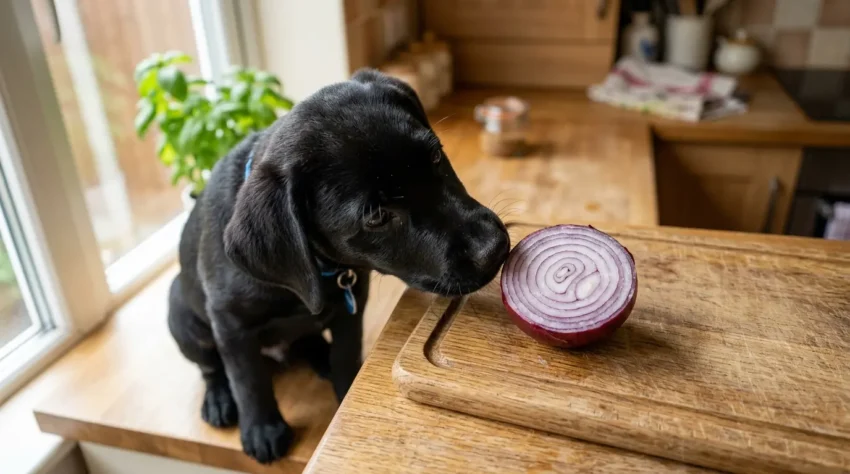
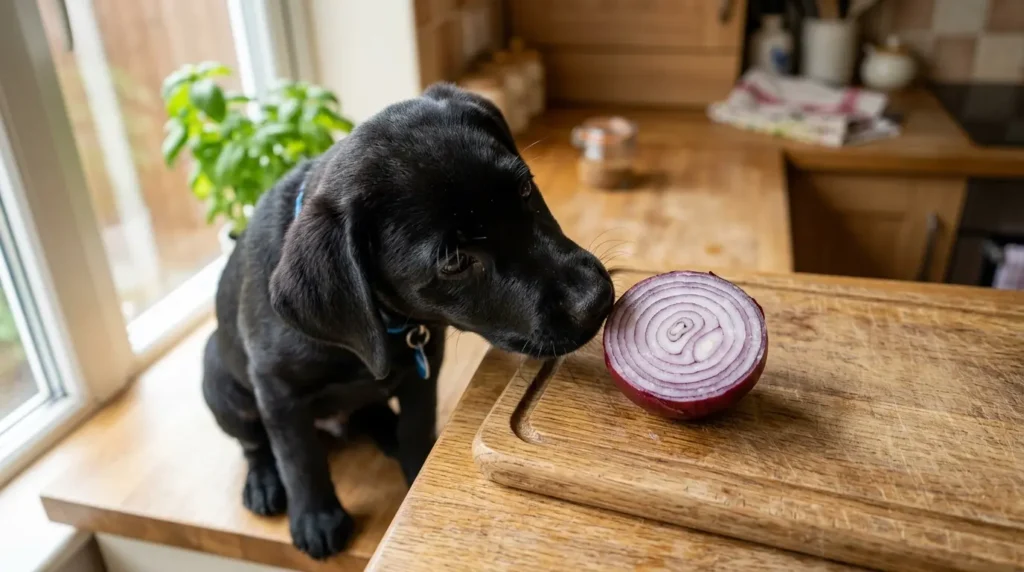
Unlike most foods on this site, this one has a simple, unqualified answer. There’s no “in moderation,” no “small amounts are “fine”—onions are toxic to dogs, full stop.
Quick Answer
No, dogs should never eat onions in any form. Onions contain compounds that damage red blood cells and can cause thrombolytic anemia, a serious and potentially life-threatening condition. This applies to raw, cooked, powdered, and dehydrated onions equally—there is no safe amount and no safe preparation method.
Key Takeaways
- Onions are toxic to dogs in every form—raw, cooked, powdered, or dehydrated
- The toxin is sulfate, which destroys red blood cells and causes thrombolytic anemia
- Symptoms are often delayed by one to several days, which makes this especially dangerous
- Akita and Chiba ins are genetically more sensitive
- Onion powder is more concentrated than fresh onion and hides in many processed foods
Why Onions Are Toxic to Dogs
<cite index=”22-1″>Onions contain sulfate compounds that are harmless to humans but toxic to dogs because dogs lack the enzymes needed to break them down safely</cite>. Here’s what actually happens in the body: <cite index=”23-1″>The toxin causes oxidative damage to red blood cells by attaching to the oxygen molecules within them, reducing their ability to carry oxygen and triggering the immune system to attack and destroy the damaged cells—a process called hydrolysis.
<cite index=”27-1″>This results in Heinz body thrombolytic anemia, a condition documented in dogs, cats, and even food-producing animals after ingesting onions or garlic in any form</cite>. <cite index=”26-1″> he toxic dose is estimated at roughly 15 to 30 grams of onion per kilogram of a dog’s body weight—meaning even a moderate amount can be dangerous for a small dog.
Every Form Is Dangerous—There’s No “Safer” Version
| Form | Safe? | Notes |
|---|---|---|
| Raw onion | No | Fully toxic |
| Cooked onion | No | Cooking does not remove the toxin. |
| Onion powder | No—most concentrated | <cite index=”29-1″>Roughly 5x more concentrated than fresh onion</cite> |
| Dehydrated/granulated onion | No | Equally toxic as fresh |
| Onion in broth/stock | No | Toxin leaches into liquid. |
| Green onions/scallions | No | Same allium family risk |
| Chives, leeks, shallots | No | All allium species carry the same risk. |
<cite index=”28-1″>There is no safe amount, no safe preparation method, and no breed that is immune—this applies across the entire allium family, not just onions specifically.
Hidden Sources of Onion Exposure
Onion and garlic powder show up in more places than most owners expect:
- Baby food (sometimes used as a bland food substitute for sick dogs—don’t, unless verified onion-free)
- Soup mixes, gravy, and stock cubes
- Pizza sauce and tomato-based sauces
- Bread products like onion rolls or garlic bread
- Seasoned or marinated meats
- Some commercial pet treats—always check labels
<cite index=”28-1″>Even “natural flavoring” on an ingredient label can include onion derivatives, so it’s worth reading labels carefully on any table food you’re considering sharing</cite>.
Breed-Specific Risk: Akita and Chiba ins
<cite index=”24-1″>Japanese breeds like Akita and Chiba ins are more prone to onion poisoning due to genetic differences that make their red blood cells more fragile and less able to withstand oxidative damage</cite>. If you own one of these breeds, treat onion avoidance as an even higher priority—the threshold for harm is lower.
Symptoms and Timeline
<cite index=”26-1″>Onset is typically delayed by several days, though large doses can cause anemia symptoms in as little as one day</cite>. This delayed onset is the most important—and most dangerous—thing to understand about onion toxicity: your dog can seem completely fine the day they eat onion and still be in trouble.
| Timeframe | Symptoms |
|---|---|
| Immediate (hours) | <cite index=”26-1″>Vomiting, diarrhea, gastrointestinal upset</cite> |
| 1–5 days | <cite index=”23-1″>Weakness, pale gums, elevated heart rate, panting, lethargy</cite> |
| Severe/late-stage | <cite index=”26-1″>Visible signs of anemia, potential organ stress</cite> |
Emergency Guide: My Dog Ate Onion
Call your vet or the ASPCA Animal Poison Control Center immediately—don’t wait to see if symptoms appear, since onset is often delayed by days. Note roughly how much and what form of onion your dog ate (raw, cooked, or powder), as this affects urgency. <cite index=”23-1″>Your vet will likely check for Heinz bodies on a blood smear alongside a recent history of onion exposure to confirm toxicity</cite>.
Common Mistakes
- Assuming cooking “neutralizes” the toxin—it doesn’t.
- Sharing pizza, soup, or sauce without checking for onion/garlic content
- Not reading ingredient labels for “onion powder” or vague “natural flavoring”
- Waiting to see symptoms before calling a vet, given the delayed onset
- Assuming “just a little lick” of onion-seasoned food is automatically fine
- Using baby food as a bland sick-dog food without checking for onion powder (a surprisingly common ingredient)
Onion Myths vs. Facts
Myth: “A tiny bit of onion powder in a sauce won’t hurt my dog.” Fact: Onion powder is more concentrated than fresh onion, and there is no established “safe” threshold—the toxic dose scales with body weight, so small dogs are at risk from smaller amounts too.
Myth: “If my dog doesn’t show symptoms right away, they’re fine.” Fact: Symptoms are often delayed by one to several days. A calm dog the day of exposure is not proof nothing happened.
Myth: “Cooking onions makes them safe, like it does with some other foods.” Fact: Cooking does not break down sulfate. Raw, cooked, dried, and powdered onion are all equally dangerous.
Expert Tips
Veterinarians treating onion toxicity emphasize that owners often underestimate risk because the dog “seems fine” in the hours after eating onion—this is exactly the delayed-onset trap that makes onion poisoning more dangerous than many acute toxins. If you know or strongly suspect your dog ate onion in any form, the standard recommendation is to contact your vet immediately rather than adopting a wait-and-see approach, since early decontamination (like inducing vomiting, if done promptly and correctly by a professional) is far more effective before absorption than treatment after symptoms appear days later.
Should You Feed Your Dog Anything With Onion? (Quick Decision Guide)
- Does it contain onion, garlic, leeks, shallots, or chives in any form? If yes—don’t feed it. No exceptions.
- Is it a processed food with “natural flavoring” or unclear seasoning? If unclear—check the label or skip it.
- Did your dog just eat something with onion in it? Call your vet now—don’t wait for symptoms.
- Is your dog an Akita or Chiba inure? Be even more vigilant—their risk threshold is lower.
FAQs
Are onions toxic to dogs? Yes, in every form—raw, cooked, powdered, or dehydrated. There is no safe amount.
How much onion is dangerous for a dog? Roughly 15–30 grams per kilogram of body weight, though smaller dogs and sensitive breeds can be affected by less.
What if my dog licked something with onion in it? A small lick of sauce is different from eating a chunk of onion, but if you’re unsure of quantity, call your vet—better to check than assume it’s fine.
Can dogs eat onion powder? No—it’s more concentrated than fresh onion and shows up in many processed foods.
Are some breeds more at risk? Yes, Akita and Chiba ins are genetically more susceptible due to differences in red blood cell fragility.
Is garlic more or less dangerous than onion? More—garlic is generally considered several times more potent than onion in causing the same thrombolytic anemia.
Can dogs eat onion that’s been fully cooked into a dish, like soup? No—the sulfate remains in the food and can even leach into cooking liquid, so a broth or soup made with onion is still dangerous even without solid onion pieces present.
Onions vs. Other Toxic Foods
| Food | Toxic? | Mechanism |
|---|---|---|
| Onions | Yes—always. | Hemolytic anemia (thiosulfate) |
| Garlic | Yes—always, more potent. | Hemolytic anemia (thiosulfate) |
| Grapes/Raisins | Yes—always. | Kidney failure (mechanism unclear) |
| Chocolate | Yes—dose dependent | Theobromine toxicity |
| Avocado (skin/pit) | Risk, not toxic like above | Persin, choking |
Final Verdict
Onions are one of the clearest “never” foods on this entire site—no moderation exception, no safe preparation method, no size that makes it fine. Keep onions, onion powder, and anything made with them completely out of reach, and if your dog does get into any amount, call your vet rather than waiting for symptoms that may not show for days.