

Quick Answer: Yes, dogs can eat oranges. The flesh is safe and offers vitamin C, fiber, and potassium in small amounts. Remove the peel, pith, and seeds first, and keep servings small — oranges are high in natural sugar and citric acid, so too much can cause an upset stomach.
Key Takeaways
- Dogs can eat the flesh of oranges, including mandarins and clementines, in moderation
- Always remove the peel, pith, and seeds before feeding
- 1–2 small segments for small dogs, up to 2–3 for large dogs, a few times a week
- Orange peel and essential oils aren’t classically toxic but can cause digestive upset and pose a choking or blockage risk
- Dogs with diabetes, obesity, or sensitive stomachs should avoid oranges or get vet guidance first
- Oranges are higher in natural sugar than fruits like blueberries, so they belong in the “occasional treat” category, not an everyday snack
What Are Oranges, and Why Do Owners Search for This?
Oranges are a citrus fruit prized for their sweetness, juiciness, and high vitamin C content. They’re one of the most commonly eaten fruits in American households, which is exactly why so many dog owners find themselves googling can dogs eat oranges the moment their dog starts sniffing around while they’re peeling one at the kitchen counter. Dogs are naturally curious about the foods we eat, and citrus has a strong, appealing scent that tends to catch their attention immediately.
This question also comes up in a few closely related forms — owners ask about mandarins, clementines, “cuties” (a branded mandarin variety), and blood oranges just as often as standard navel oranges. The good news is that all of these varieties are part of the same citrus family and follow essentially the same safety guidelines, so one clear answer covers nearly every version of this fruit you’ll find in a grocery store.
Understanding this topic also means understanding a few related entities: citric acid, essential oils found in citrus peel, psoralens (a compound found in higher concentration in citrus rind), and natural fruit sugars. None of these make oranges dangerous in the way that grapes or chocolate are dangerous to dogs — but they do explain why moderation and preparation matter more with oranges than with something like blueberries.
Direct Answer: Are Oranges Good for Dogs?
Yes. Oranges are generally safe and can even be modestly beneficial for dogs when given the right way. The orange segment itself — the soft, juicy part you’d eat — contains no toxic compounds for dogs. Veterinarians commonly list oranges among the acceptable “human fruits” for dogs, usually with the same caveat: moderation matters because of the sugar content, and preparation matters because of the peel.
Where oranges differ from a fruit like blueberries is nutritional density versus sugar load. Oranges deliver real nutritional value, but they also deliver noticeably more natural sugar per serving, which is the main practical reason vets recommend treating them as an occasional snack rather than a daily addition to your dog’s diet.
Why Are Oranges Safe for Dogs? The Biology Behind the Answer
It helps to understand why this answer is yes, not just accept it at face value. Dogs, unlike humans, actually synthesize their own vitamin C internally through liver function — they don’t have a dietary requirement for it the way people do. This means oranges aren’t providing something a healthy dog is otherwise missing; they’re simply a safe, flavorful source of hydration, fiber, and a modest antioxidant boost.
From a toxicology standpoint, the orange fruit itself has never been associated with the kind of serious, systemic toxicity seen with grapes, raisins, or xylitol. The parts of the citrus plant that can cause a genuine problem — the peel, the white pith, and to a lesser extent the seeds — contain a higher concentration of essential oils and compounds called psoralens. In large enough quantities, these can cause gastrointestinal upset, and in some individual dogs, mild skin sensitivity if citrus oil comes into direct contact with their fur or skin. This is a digestive and irritation risk, not a poisoning risk, which is an important distinction that often gets lost in generic “is X bad for dogs” content online.
Veterinary nutritionists generally categorize oranges the same way they categorize apples or pears: a fruit that is fine in small amounts for a healthy adult dog, but not something to build a feeding routine around, and not appropriate for dogs with certain metabolic conditions discussed later in this guide.
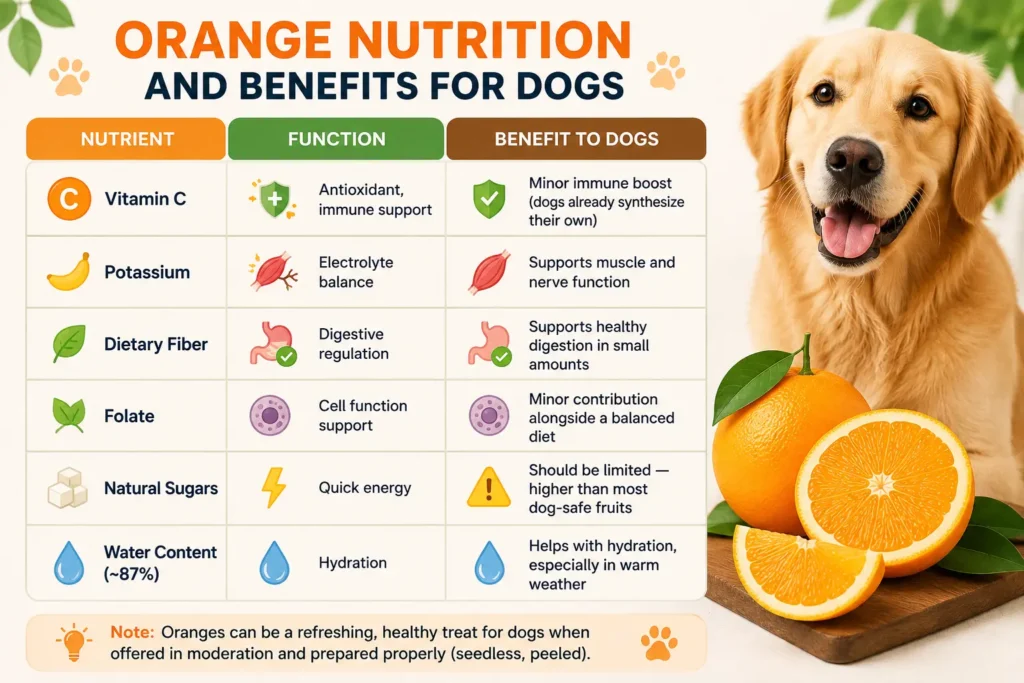
Nutritional Profile of Oranges
| Nutrient | Function | Benefit to Dogs |
|---|---|---|
| Vitamin C | Antioxidant, immune support | Minor immune boost (dogs already synthesize their own) |
| Potassium | Electrolyte balance | Supports muscle and nerve function |
| Dietary Fiber | Digestive regulation | Supports healthy digestion in small amounts |
| Folate | Cell function support | Minor contribution alongside a balanced diet |
| Natural Sugars | Quick energy | Should be limited — higher than most dog-safe fruits |
| Water Content (~87%) | Hydration | Helps with hydration, especially in warm weather |
For context, a medium orange contains roughly three to four times the sugar of an equivalent serving of blueberries, which is the single biggest reason portion size matters more here.
Health Benefits of Oranges for Dogs
Hydration Support
With roughly 87% water content, orange segments can be a genuinely hydrating snack, particularly useful in hot weather or for dogs who don’t drink as much water as they should.
Digestive Support
The fiber in orange flesh can support regular, healthy digestion when given occasionally and in appropriate amounts — though too much can have the opposite effect and cause loose stool.
Antioxidant Content
Flavonoids and other antioxidant compounds found in citrus fruits contribute to overall cellular health, complementing (not replacing) a complete and balanced commercial diet.
Low-Fat Treat Alternative
Compared to many processed dog treats, which can be surprisingly high in fat, a small orange segment is naturally fat-free, making it a reasonable occasional swap for dogs on a weight management plan — provided the sugar content is accounted for.
Potassium for Muscle Function
The potassium in oranges supports normal muscle contraction and nerve signaling, complementing what your dog already gets from a complete commercial diet.
Risks and Safety Warnings
- Peel and pith: Harder to digest, can cause GI upset, and pose a genuine choking or intestinal blockage risk, especially in small dogs or dogs that tend to gulp food
- Seeds: Not highly toxic in small amounts, but should be removed to avoid choking risk and to prevent a small dog from swallowing several at once
- High sugar content: Oranges contain notably more natural sugar than fruits like blueberries or strawberries — overfeeding can contribute to weight gain over time or, in diabetic dogs, meaningful blood sugar spikes
- Citric acid sensitivity: Some dogs experience stomach upset from the acidity alone, even in small servings, independent of the sugar content
- Essential oils: Concentrated citrus oil, as found in peels, zest, or cleaning products, can genuinely irritate a dog’s skin and should never be applied directly to their fur or skin
- Overripe or moldy fruit: As with any fruit, mold on citrus can produce mycotoxins that are harmful if ingested — always check freshness before sharing
Serving Guide by Dog Size
| Dog Size | Portion | Frequency |
|---|---|---|
| Small (under 20 lbs) | 1 small segment | Once or twice a week |
| Medium (20–50 lbs) | 1–2 segments | Once or twice a week |
| Large (50+ lbs) | 2–3 segments | Once or twice a week |
As with any treat, keep oranges under 10% of your dog’s total daily calorie intake, and always introduce a small piece first to check tolerance before making it a regular addition.
Step-by-Step Feeding Guide
- Choose fresh, ripe oranges — avoid any fruit that’s moldy, overripe, or has an off smell
- Peel completely, removing all of the white, stringy pith along with the outer peel
- Remove all seeds from each segment before offering it
- Cut into small, size-appropriate pieces — smaller for toy and small breeds, slightly larger is fine for big dogs
- Offer one piece first and wait roughly 24 hours to check for any digestive upset before giving more
- Store leftovers properly in the refrigerator and avoid offering fruit that’s been sitting out for hours
Oranges vs. Other Fruits: Comparison
| Fruit | Safe for Dogs? | Sugar Level | Best For |
|---|---|---|---|
| Oranges / Mandarins / Clementines | Yes, peeled and seeded | Moderate-High | Occasional vitamin C and hydration boost |
| Blueberries | Yes | Low | Everyday low-calorie treat, antioxidants |
| Mango | Yes, peeled and pitted | High | Occasional treat only, due to sugar |
| Grapefruit / Lemons | Not recommended | High acidity | Best avoided due to acidity and citrus oil concentration |
| Grapes / Raisins | No — toxic | N/A | Avoid entirely; can cause acute kidney failure |
If you’re building a rotation of fruit treats for your dog, a useful rule of thumb is to lean on lower-sugar options like blueberries for regular, frequent treats, and reserve higher-sugar fruits like oranges and mango for occasional, smaller servings.
Real Owner Scenarios
Scenario 1: Sharing a Snack Time Orange
Situation: An owner is peeling an orange at the kitchen table and their dog is sitting there, clearly begging for a piece.
Recommendation: One small, fully peeled and seeded segment is fine as an occasional treat — there’s no need to feel guilty about sharing a little.
Takeaway: A little sharing is genuinely fine, but don’t turn it into a daily habit given the sugar content.
Scenario 2: Dog Got Into a Bowl of Oranges, Peel Included
Situation: A dog got into a fruit bowl and ate a whole orange, peel and all, while the owner wasn’t watching.
Recommendation: Monitor closely for vomiting, diarrhea, lethargy, or signs of a blockage (straining, refusal to eat, a hard or painful abdomen) over the next 24–48 hours. Contact your vet promptly if any of these appear, or immediately if your dog is a small or toy breed.
Takeaway: Whole peels, not the flesh, are the main real risk with oranges — supervision around a fruit bowl matters more than the fruit itself.
Scenario 3: Diabetic Senior Dog
Situation: An owner with a diabetic senior dog wants to know whether oranges are still an option as an occasional treat.
Recommendation: Because of the sugar content, check with your veterinarian before offering oranges to a diabetic dog. A lower-sugar option like blueberries or a small piece of cucumber is often a safer default in this situation.
Takeaway: Underlying health conditions change the calculus — what’s fine for a healthy adult dog may not be the best choice for a dog managing diabetes.
Scenario 4: New Puppy Owner Wants a Training Treat
Situation: A new puppy owner is looking for low-calorie, natural training treats and wonders if orange segments would work.
Recommendation: Very small pieces can work occasionally, but the sugar content and acidity make oranges a less ideal everyday training treat compared to something like small pieces of plain cooked chicken or a low-sugar fruit.
Takeaway: Oranges can be part of a treat rotation, but they shouldn’t be the primary training reward.
Common Mistakes
- Feeding the peel along with the flesh, assuming that because the fruit is safe, every part of it must be too
- Not removing seeds before giving segments to small dogs or puppies
- Offering too much at once, which can cause stomach upset from the combination of acidity and sugar
- Giving orange-flavored products like juice, candy, or baked goods instead of real fruit — these often contain added sugar, artificial flavoring, or in some cases xylitol
- Assuming all citrus fruits are interchangeable when some, like grapefruit and lemon, are considerably more acidic and less appropriate to share
Myths vs. Facts
| Myth | Fact |
|---|---|
| Oranges are toxic to dogs | The flesh is not toxic; the peel and pith just cause digestive upset, not poisoning |
| Dogs need vitamin C from fruit | Dogs produce their own vitamin C naturally, so oranges are a bonus, not a dietary requirement |
| All citrus fruits are equally safe | Grapefruit and lemons are much more acidic and generally not recommended, unlike oranges or mandarins given in moderation |
| Orange juice is a good substitute for the fruit | Juice concentrates the sugar and strips out the fiber, making it a notably worse option than fresh segments |
| A dog that eats orange peel will definitely get sick | Most dogs experience mild, self-resolving upset at worst; serious blockages are uncommon but more likely in small dogs or with large amounts |
Expert Tips
- Freeze small, peeled orange segments for a refreshing treat on hot days
- Mandarins and clementines are easier to peel and portion than full-size oranges — a convenient option if you want smaller, training-treat-sized pieces
- Always introduce a new fruit one small piece at a time to identify any individual sensitivity early, rather than offering a full serving right away
- Keep fruit bowls out of reach if your dog has a history of counter-surfing, since the peel poses more risk than the flesh
Breed-Specific Notes
- Small and toy breeds: More sensitive to seeds and peel as blockage risks — cut pieces extra small and supervise closely
- Large and giant breeds: Can typically tolerate slightly larger segments without issue, though the same sugar guidelines still apply
- Senior dogs: Watch sugar intake more closely, especially if managing weight, joint health, or blood sugar
- Puppies: Introduce only after around 8 weeks old, in a tiny, well-supervised portion, watching closely for any digestive reaction
Special Health Conditions
- Diabetic dogs: Oranges’ higher sugar content makes them a less ideal choice — consult your vet before feeding, and consider a lower-sugar alternative instead
- Dogs with sensitive stomachs: Citric acid can trigger upset even in small amounts — start with a very small taste and watch closely
- Overweight dogs: Treat oranges as an occasional rather than regular snack, given the sugar content relative to lower-calorie fruit options
- Dogs on prescription diets: Check with your vet before adding any new treat, including fruit, outside a prescribed therapeutic diet
Practical Checklist: Is This Orange Safe to Share?
- Is it fresh, ripe, and free of mold? → Continue
- Have you removed the peel and all pith? → Continue
- Have you removed all visible seeds? → Continue
- Is your dog healthy, with no diabetes or known citrus sensitivity? → Continue
- Is the portion appropriate for your dog’s size? → Yes — safe to share
- If any answer is no — skip it, or check with your vet first
This quick checklist is worth keeping in mind any time a new fruit question comes up, not just for oranges — the same basic logic (fresh, prepared correctly, appropriate portion, no underlying condition that changes the answer) applies across most of the fruit guides on this site.
How Oranges Compare Across the Citrus Family
| Citrus Fruit | Sweetness | Ease of Prep | Notes for Dogs |
|---|---|---|---|
| Navel Oranges | Moderate | Medium (more pith to remove) | Standard choice, follow general guidelines above |
| Mandarins / Clementines | High | Easy (thin peel, less pith) | Convenient for small training-treat portions |
| Blood Oranges | Moderate | Medium | Same guidelines as standard oranges |
| Grapefruit | Low (bitter) | Medium | Not recommended; much higher acidity |
Frequently Asked Questions
Can dogs eat orange peels?
It’s best to avoid feeding orange peels. They’re harder to digest, can cause stomach upset, and pose a choking or blockage risk, especially in small dogs.
Are mandarins and clementines safe for dogs?
Yes, mandarins and clementines follow the same safety guidelines as regular oranges — peeled, seeded, and given in moderation.
Can puppies eat oranges?
Yes, in very small amounts after around 8 weeks old, with the peel, pith, and seeds fully removed and close supervision.
Are oranges bad for dogs?
Oranges aren’t inherently bad for dogs, but their higher sugar content means they should be an occasional treat rather than a regular part of the diet.
Can dogs eat blood oranges?
Yes, blood oranges follow the same guidelines as regular oranges — peeled, seeded, and fed in small amounts.
What happens if my dog eats orange peel?
Most dogs will just experience mild stomach upset, but monitor for vomiting, diarrhea, lethargy, or signs of a blockage, and contact your vet if symptoms are severe or persistent.
Can dogs have orange juice?
It’s not recommended. Orange juice concentrates the natural sugar and removes the fiber found in the whole fruit, making it a less healthy option.
Are oranges safe for dogs with diabetes?
Check with your veterinarian first — oranges’ sugar content makes them less ideal for diabetic dogs compared to lower-sugar fruits like blueberries.
How many orange segments can I give my dog?
Generally 1 segment for small dogs, 1–2 for medium dogs, and 2–3 for large dogs, a couple of times a week.
Can dogs eat other citrus fruits like lemons or grapefruit?
These are much more acidic and generally not recommended for dogs, unlike oranges or mandarins given in moderation.
Is orange peel toxic or just an irritant?
It’s an irritant and a mechanical risk (choking, blockage), not a toxin in the way grapes or xylitol are. The distinction matters for how urgently you should react.
Can dogs eat dried or dehydrated orange slices?
Plain, unsweetened dried orange can be given in very small amounts, but dried fruit is more calorie- and sugar-dense per bite, so portions should be even smaller than fresh fruit.
Do oranges help with a dog’s immune system?
They may offer a small antioxidant contribution, but dogs already produce their own vitamin C, so oranges are a nice bonus rather than a meaningful immune boost.
Can dogs eat orange seeds?
A seed or two swallowed by accident is unlikely to cause serious harm, but seeds should still be removed as a precaution, particularly for small dogs.
What’s the difference between oranges and mandarins for dogs?
Nutritionally, they’re very similar. Mandarins are often smaller, sweeter, and easier to peel, which some owners find more convenient for portioning small treats.
For more vitamin C-rich and antioxidant options, see our guides to blueberries and pineapple.
Final Verdict
Oranges can be a safe, occasional treat for most healthy dogs when the peel, pith, and seeds are removed and portions stay small. The main things to watch are the natural sugar content and the digestive risk from the peel — not the orange flesh itself, which contains no toxic compounds for dogs. If your dog has diabetes, weight concerns, or a sensitive stomach, check with your vet first, or consider reaching for a lower-sugar fruit like blueberries instead.
Related Articles
Read more in our Can Dogs Eat Blueberries guide, browse the full Dog Food Guide, or check our Fruits category for more safe fruit guides.
This article is for general informational purposes and is not a substitute for advice from your veterinarian. See our full disclaimer. Last updated: August 2026.