
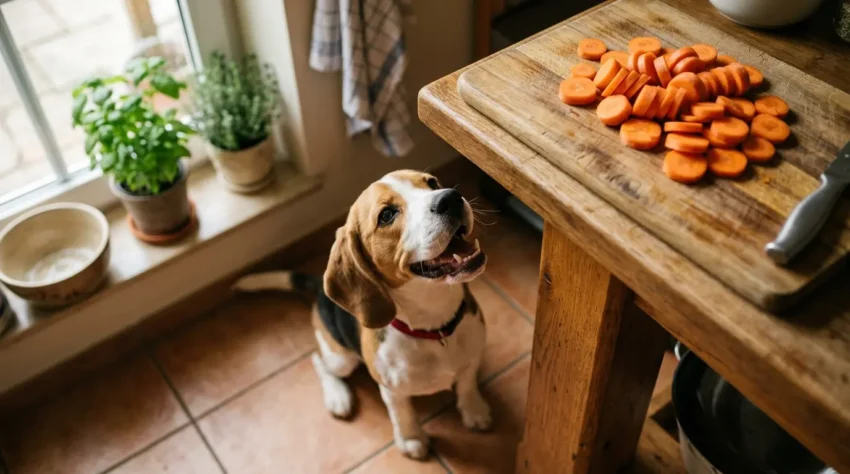
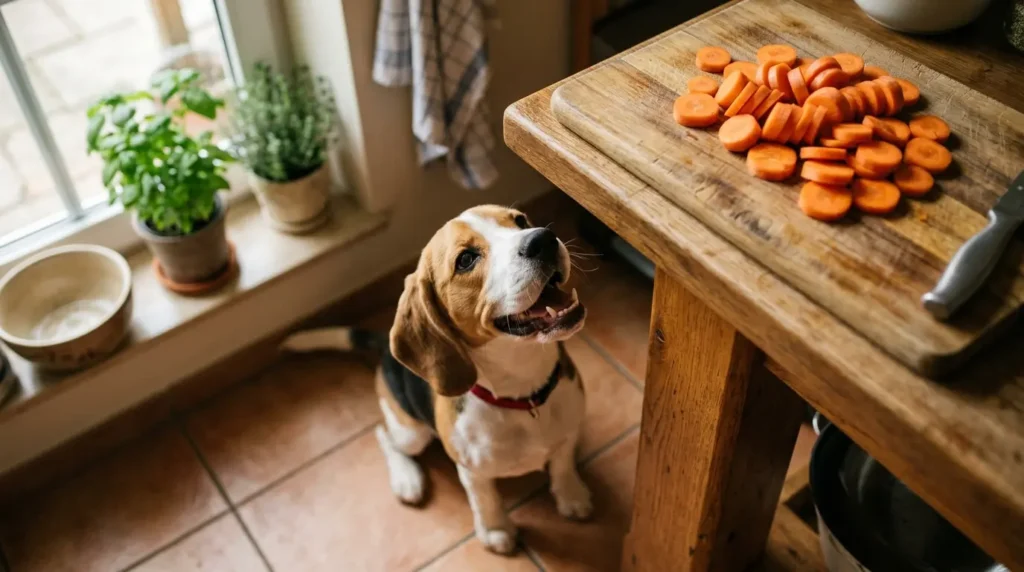
Of every vegetable dog owners ask about, carrots are the easiest yes. They’re genuinely good for dogs — the only real work is in how you cut and serve them.
Quick Answer
Yes, dogs can eat carrots — raw or cooked, including the greens. Carrots are low in calories and rich in beta-carotene, fiber, and antioxidants that support eye health and digestion. The main risk is choking on large or improperly cut pieces, especially round coin shapes, so cut them into sticks or bite-size pieces instead.
Key Takeaways
- Carrots are safe raw or cooked, for adult dogs and puppies
- Beta-carotene (vitamin A) supports eye health and immune function
- Raw carrots help clean teeth through the chewing action
- Avoid round coin-cut pieces — they’re a choking risk
- Carrot greens are also safe, just slightly bitter
Are Carrots Safe for Dogs?
Yes, without much qualification. <cite index=”32-1″>Carrots are safe and healthy for most dogs, providing vitamins, minerals, fiber, and antioxidants that support eye health, digestion, skin, and coat</cite>. <cite index=”31-1″>Dogs can eat carrots raw or cooked, as long as they’re served plain and in moderation</cite>.
Health Benefits of Carrots
| Nutrient | Benefit |
|---|---|
| Beta-carotene (Vitamin A) | <cite index=”37-1″>Supports vision, skin, and immune health</cite> |
| Fiber | Supports digestion and regular bowel movements |
| Low calorie | Ideal for weight management or as a diet-friendly treat |
| Antioxidants | Supports cellular health |
| Crunchy texture (raw) | <cite index=”35-1″>Helps scrape plaque and support dental health while chewing</cite> |
Raw vs. Cooked — Which Is Better?
Both are good options, and the choice mostly comes down to your dog’s preference and dental needs. <cite index=”38-1″>Cooking reduces some nutrients like vitamin C, but actually increases the availability of others, like beta-carotene</cite>. <cite index=”35-1″>Raw carrots offer a dental health bonus through chewing, while cooked carrots are softer and easier for senior dogs or dogs with dental issues to eat</cite>.
If your dog has no dental issues and enjoys the crunch, raw is a great default. If they’re older or have sensitive teeth, steamed or boiled plain carrots work just as well nutritionally.
Safe Cutting Shapes — The Detail Most Owners Miss
<cite index=”37-1″>Skip round coin-cut pieces, which can lodge in a dog’s throat if they gulp rather than chew</cite>. Safer options: cut into short sticks, half-moons, or grate the carrot entirely as a food topper. <cite index=”32-1″>Whichever shape you choose, cutting into small, bite-size pieces reduces the risk of choking or blockage compared to giving a whole carrot</cite>.
Can Dogs Eat Carrot Greens?
Yes. <cite index=”38-1″>Carrot greens are safe for dogs and are rich in vitamins and minerals, though they have a slightly bitter taste that softens with blanching or light cooking</cite>. If you grow carrots at home, there’s no need to toss the tops — just wash and lightly cook them before offering a small amount.
Puppies and Frozen Carrots
<cite index=”31-1″>Carrots can be a good choice for puppies as long as they’re cut into tiny pieces to prevent choking, and they can help with teething</cite>. <cite index=”33-1″>Large frozen carrots also work well as an inexpensive, edible chew toy that can soothe teething discomfort</cite>. As with adult dogs, carrots should stay a moderate addition, not a diet staple, for growing puppies.
How Much Carrot Can a Dog Eat?
| Dog Size | Portion Guide |
|---|---|
| Small/Puppy | 1–2 small pieces or sticks |
| Medium | A small handful, chopped |
| Large | Up to a whole carrot, cut into pieces |
Keep carrots, like all treats, to under 10% of your dog’s daily caloric intake.
What to Avoid
- Carrot cake — high sugar, sometimes contains xylitol
- Glazed or candied carrots — added sugar and butter
- Canned carrots with added salt
- Carrots cooked with garlic, onion, or seasoning
- Carrot soup or juice with unknown added ingredients
Common Mistakes
- Feeding whole carrots without cutting them down
- Cutting into round coins instead of sticks or half-moons
- Assuming carrot-flavored human snacks (cake, glazed dishes) are the same as plain carrots
- Overfeeding because carrots seem “totally safe” — moderation still applies
- Skipping the wash step on garden-grown carrots (pesticide/dirt residue)
- Giving a whole large carrot to a small dog as a chew, unsupervised
Carrot Myths vs. Facts
Myth: “Carrots are so healthy, there’s basically no limit.” Fact: Carrots are genuinely low-risk, but still count toward the 10% treat rule — too many can cause digestive upset or unnecessary sugar intake over time.
Myth: “Raw carrots are always better than cooked for dogs.” Fact: Raw offers a dental-health bonus, but cooked carrots actually have higher available beta-carotene — neither is strictly “better,” they suit different needs.
Myth: “Carrot greens are toxic like tomato leaves.” Fact: Carrot greens are safe for dogs, unlike some other vegetable plant tops. They’re just slightly bitter, which cooking helps with.
Expert Tips
Veterinarians often recommend carrots specifically as a stand-in for higher-calorie commercial treats when a dog needs to lose weight, since they’re low-calorie, filling due to fiber, and most dogs enjoy the crunch. For senior dogs or dogs recovering from dental work, steamed carrots offer nearly identical nutritional value without the chewing demand of raw. If you’re using frozen carrots as a teething aid for a puppy, supervise the first few sessions to make sure your puppy is gnawing rather than trying to swallow large frozen chunks whole.
Should You Feed Your Dog Carrots? (Quick Decision Guide)
- Is it a plain carrot — root, or well-washed greens? If yes — good to go.
- Is it cut into sticks, half-moons, or grated (not coins)? If no — re-cut it first.
- Does your dog have dental sensitivity? If yes — go with cooked over raw.
- Is it carrot cake, glazed, or juice with added ingredients? If yes — skip it.
FAQs
Can dogs eat raw carrots? Yes, raw carrots are safe and offer a dental health bonus from the chewing action. Cut into safe shapes to avoid choking.
Can dogs eat cooked carrots? Yes, cooked (steamed, boiled, or baked) carrots are just as safe and easier to digest for dogs with dental issues.
Can dogs eat carrot greens? Yes, carrot greens are safe, though slightly bitter — lightly cooking them helps.
Can puppies eat carrots? Yes, in small, well-cut pieces. Frozen carrots also make a good teething chew.
How many carrots can a dog eat? Keep it to a small handful for medium/large dogs, a couple of small pieces for small dogs — carrots should stay under 10% of daily calories.
Can dogs eat carrot juice? In small amounts, plain and without added sugar — but whole carrots offer more fiber and are generally the better choice.
Are baby carrots different from regular carrots for dogs? No meaningful difference — baby carrots are just pre-cut regular carrots, and are convenient since they’re already close to a safe serving size.
Carrots vs. Other Vegetables
| Food | Safe? | Key Risk |
|---|---|---|
| Carrots | Yes | Choking if not cut properly |
| Broccoli | Yes, moderation | Gas/GI upset in large amounts |
| Corn kernels | Yes, moderation | Minimal |
| Potatoes | Yes, cooked only | Solanine if raw/green |
| Onions | Never | Toxic |
Final Verdict
Carrots are one of the safest, most genuinely beneficial vegetables you can share with your dog — raw or cooked, greens included. The only real precaution is how you cut them: skip round coins, favor sticks or grated pieces, and you’ve got a low-calorie, nutrient-rich treat with almost no downside.