
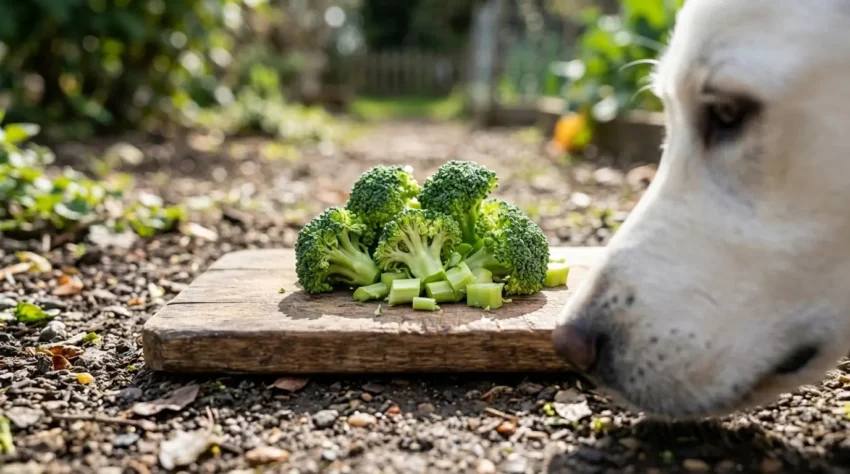
Broccoli is one of the more genuinely healthy “people foods” you can share with your dog—but you’ll find real disagreement online about which parts are safest. Here’s a clear answer.
Quick Answer
Yes, dogs can eat broccoli—florets, stalks, and even the leaves—in small amounts. The main concern is isothiocyanate, a naturally occurring compound that can cause gastric irritation in larger quantities. Keep broccoli to under 10% of your dog’s daily calories, cut it into manageable pieces to avoid choking, and introduce it slowly.
Key Takeaways
- All parts of broccoli are technically safe—florets, stalk, and leaves
- Isothiocyanate is the main risk factor, causing gas or upset in large amounts
- Stalks are tougher to chew—cut small or cook to soften
- Keep broccoli under 10% of daily calories
- Puppies should have it in very small amounts, if at all
Is Broccoli Safe for Dogs?
Yes. <cite index=”13-1″>Both florets and stalks are safe for dogs to eat, though the stalk requires extra care since it can be a choking hazard and is harder to digest</cite>. Broccoli offers real nutritional value — <cite index=”17-1″>vitamin C, vitamin K, and antioxidants that support immune function and cell health</cite>.
Isothiocyanate Explained—Resolving the Floret vs. Stalk Confusion
This is where competitor advice genuinely disagrees, so it’s worth untangling. isothiocyanate are a sulfur-based compound in broccoli responsible for most of the digestive risk — <cite index=”16-1″>in small quantities they’re harmless, but larger amounts can cause nausea, bloating, gas, diarrhea, and in some cases significant gastric irritation</cite>.
Where sources differ is which part has more of the compound: <cite index=”14-1″>one major retailer states stalks are actually lower in isothiocyanate than florets</cite>, while <cite index=”17-1″>another source claims the stem and leaves contain higher concentrations than the florets</cite>. The most consistent, vet-attributed detail across sources is that <cite index=”15-1″>the florets specifically are flagged by name as the source of gastric irritation</cite> more often than the stalk is. The practical takeaway: don’t treat either part as “the safe one” and overfeed it — moderate both florets and stalk the same way, and let portion size (not part selection) be your main safety lever.
Florets vs. Stalks vs. Leaves
| Part | Safe? | Notes |
|---|---|---|
| Florets | Yes | Softer, easier to digest, still moderate portions |
| Stalk | Yes | Tougher — chop small or cook to soften, watch choking risk |
| Leaves | Yes | Less commonly fed, similar caution as stalk |
Raw vs. Cooked Broccoli
Both are technically fine. <cite index=”19-1″>Dogs can eat raw or cooked broccoli, just not in large amounts</cite>, but <cite index=”18-1″>cooking or steaming softens the texture, making it easier to swallow and digest, especially for the stalk</cite>. If your dog is a fast eater or a smaller breed, cooked and finely chopped is the safer default.
How Much Broccoli Can a Dog Eat?
<cite index=”13-1″>Broccoli should make up less than 10% of a dog’s daily calories, with a small dog or puppy portion being roughly one floret</cite>. <cite index=”17-1″>As a rough guide, a dog eating one cup of food per day shouldn’t get more than about 2 tablespoons of broccoli</cite>.
| Dog Size | Portion Guide |
|---|---|
| Small/Puppy | 1 small floret |
| Medium | 1–2 tablespoons, chopped |
| Large | 2–3 tablespoons, chopped |
Puppies and Broccoli
<cite index=”18-1″>Adult dogs can generally handle broccoli, but puppies are better off avoiding it — their digestive systems are still developing and are more sensitive to the fiber and isothiocyanate content</cite>. If you do want to introduce it, wait until your puppy is older and start with an extremely small amount.
Common Mistakes
- Feeding broccoli as a large “healthy” portion instead of a small treat
- Giving whole, uncut stalk pieces to small dogs (choking risk)
- Assuming one part (floret or stalk) is “the safe one” and overfeeding it
- Cooking broccoli with butter, oil, or seasoning
- Introducing a large amount on the first try instead of a small test portion
- Feeding broccoli to a puppy expecting the same tolerance as an adult dog
Broccoli Myths vs. Facts
Myth: “Broccoli is mildly toxic to dogs because of isothiocyanate.” Fact: isothiocyanate aren’t a toxin in the poisoning sense they’re a digestive irritant in large amounts. Small portions are genuinely fine for most dogs.
Myth: “The stalk should always be avoided.” Fact: The stalk is safe — it just needs more prep (chopping or cooking) due to its tougher texture, not because it’s inherently more dangerous.
Myth: “More broccoli means more health benefit, since it’s a superfood.” Fact: Past a small portion, extra broccoli just adds gas and GI upset risk without added benefit — the 10% treat rule caps this for a reason.
Expert Tips
Vets generally recommend introducing any cruciferous vegetable — broccoli included — gradually and in isolation, rather than as part of a mixed vegetable medley the first time. This makes it much easier to identify if broccoli specifically caused any gas, bloating, or loose stool, versus another new ingredient getting the blame. If your dog tolerates a small floret well over a few tries, you can feel reasonably confident increasing the portion slightly within the 10% guideline.
Should You Feed Your Dog Broccoli? (Quick Decision Guide)
- Is it plain, unseasoned broccoli? If no — don’t feed it.
- Is the stalk cut small or cooked to soften? If no — cut it down first.
- Is your dog a puppy? If yes — wait until they’re older, or offer a tiny test amount only.
- Is the portion under 10% of daily calories? If no — scale it back.
FAQs
Can dogs eat broccoli stalks? Yes, but they’re tougher to chew and digest than florets — cut them small or cook them to soften first.
Is raw broccoli safe for dogs? Yes, in small amounts, though cooked broccoli is easier to digest, particularly the stalk.
Can dogs eat broccoli leaves? Yes, though they’re less commonly fed and should be treated with the same portion caution as the stalk.
How much broccoli can I give my dog? Keep broccoli under 10% of your dog’s daily calories — roughly 1–3 tablespoons depending on size.
Can puppies eat broccoli? It’s best to wait until they’re older; puppies’ digestive systems are more sensitive to broccoli’s fiber and isothiocyanate content.
Does broccoli cause gas in dogs? It can, particularly in larger amounts — this is one of the most common and mildest side effects, not a sign of danger.
Is broccoli better than other cruciferous vegetables for dogs? Broccoli, cauliflower, and Brussels sprouts share a similar risk profile (gas, GI upset in excess). None is clearly “safer” than the others — moderation applies across all of them.
Broccoli vs. Other Vegetables
| Food | Safe? | Key Risk |
|---|---|---|
| Broccoli | Yes, moderation | Gas/GI upset in large amounts |
| Carrots | Yes | Choking if not cut properly |
| Corn kernels | Yes, moderation | Minimal |
| Spinach | Yes, small amounts | Oxalates in excess |
| Onions | Never | Toxic |
Final Verdict
Broccoli is a genuinely healthy, low-calorie treat for most dogs when kept to small, occasional portions. All parts — florets, stalk, and leaves — are technically safe; the real safety lever is quantity, not which part you choose. Start small, watch for gas or stomach upset, and keep it as an occasional add-on rather than a regular menu item.