
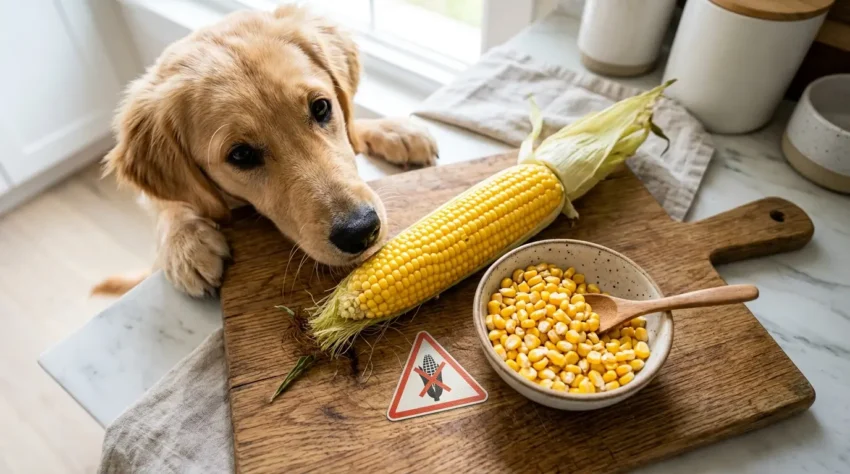
Quick answer: Yes—plain, cooked corn kernels are safe for dogs in small amounts and offer real nutritional value, including protein, fiber, and healthy fats. The cob, however, is a serious choking and intestinal blockage hazard and should never be given to dogs. Always remove kernels from the cob before sharing.
Key Takeaways
- Plain corn kernels are safe for dogs in moderation—corn on the cob is a genuine medical emergency risk
- Corn offers dogs real nutritional value, including protein, fiber, and linoleum acid
- Canned corn is generally safe if it’s low-sodium—always check the label
- Puppies can eat plain corn, but introduce it slowly and in very small amounts
- Corn allergies in dogs are rare but real—knowing the signs matters
- Corn on the cob is one of the most common causes of intestinal blockage surgeries in dogs
Your dog is eyeing your corn on the cob at a summer BBQ, and before you know it, a kernel has hit the floor and disappeared. Sound familiar? Most dog owners have been there. The question that follows is an honest one: “Was that okay?”
The short answer is yes — plain corn kernels are safe for your dog. But the full answer depends on the form corn takes, how much your dog eats, and whether certain health conditions apply. A loose kernel on the kitchen floor is very different from your dog gnawing on a whole cob, and that distinction matters more than most people realize.
This guide covers every corn format your dog might realistically encounter — from raw kernels and canned corn to popcorn, tortillas, and corn on the cob. You’ll also find practical serving size guidance by dog weight, a clear breakdown of corn allergy symptoms, and specific instructions for what to do if your dog swallows part of a cob. By the end, no question about corn and your dog should be left unanswered.
Is Corn Safe for Dogs to Eat?
Plain corn kernels are not toxic to dogs. Neither the American Kennel Club (AKC) nor the ASPCA lists corn as a harmful food for dogs, and it appears as a common ingredient in many commercially produced dog foods that meet AAFCO nutritional standards.
That said, “not toxic” and “freely give your dog as much as they want” are not the same thing. Corn is safe in reasonable amounts, as an occasional treat — not as a dietary staple. Your dog’s digestive system handles cooked corn more easily than raw corn, so plain, cooked kernels are always the better choice.
One more thing worth clearing up early: the claim that corn is nutritionally empty — a cheap filler with no value — is not accurate. Corn does contain real nutrients, and we’ll cover exactly what those are in the next section.
What Nutritional Value Does Corn Actually Offer Dogs?
Corn is not a superfood, but it’s not nutritionally worthless either. Here’s what’s actually inside that kernel:
| Nutrient | What It Does for Dogs |
| Carbohydrates | Provides a quick, accessible energy source |
| Protein (corn gluten) | Supports muscle maintenance |
| Fiber | Aids healthy digestion |
| Linoleic acid (omega-6) | Supports skin and coat health |
| Antioxidants | May support immune function |
Corn gluten meal — a by-product of corn processing used in many commercial dog foods — is a digestible protein source that has been part of canine diets for decades. Linoleic acid, an omega-6 fatty acid found in corn, contributes to a healthy coat and skin condition. The fiber content supports regular digestion.
What corn doesn’t provide is a complete nutritional profile on its own. It lacks sufficient levels of certain vitamins and minerals your dog needs from other sources. Think of corn as one useful ingredient among many — not a meal in itself.
Is Corn on the Cob Dangerous for Dogs?
Yes. This is the most important safety point in this entire article.
The cob itself is not digestible. Unlike food that breaks apart as it’s chewed, a corn cob holds its shape. If your dog swallows a piece — even a small one — it can lodge in the small intestine and cause a full or partial blockage. This is a medical emergency that often requires surgery.
Corn on the cob is one of the most frequently reported causes of intestinal foreign body obstruction in dogs seen by veterinary surgeons. The risk is real, and it applies to dogs of all sizes — though smaller dogs face even greater danger.
Watch for these signs of intestinal blockage:
- Repeated vomiting
- Lethargy or unusual tiredness
- Loss of appetite
- Straining to defecate or no bowel movement
- Whimpering or signs of abdominal pain
- Bloating
If your dog has eaten part of a corn cob, do not wait for symptoms to appear. Contact your vet immediately or call the ASPCA Animal Poison Control Center at (888) 426-4435.
Corn husks and silk carry similar risks — they’re fibrous, indigestible, and can cause gastrointestinal irritation or physical obstruction. Remove them entirely before your dog gets anywhere near an ear of corn.
The rule is simple: always strip kernels off the cob and offer only those. Never hand your dog a cob to chew, even under supervision.
Can Dogs Eat Different Types of Corn?
Not all corn is created equal, and your dog’s safety depends on knowing the difference. Here’s a practical breakdown of every corn format they’re likely to encounter.
Can Dogs Eat Cooked Corn?
Yes — cooked, plain corn kernels are the safest option for your dog. Cooking makes corn easier to digest and reduces the likelihood of gastrointestinal upset. The key word is plain. Corn prepared with butter, salt, garlic, or other seasonings passes those ingredients to your dog, and many of them — garlic and onion especially — are genuinely toxic to dogs.
Can Dogs Eat Raw Corn?
Raw corn kernels are not toxic, but they’re harder for dogs to digest than cooked kernels. Feeding raw corn increases the likelihood of loose stools or stomach discomfort. It’s not the worst thing your dog could eat, but cooked is always the better choice.
Can Dogs Eat Canned Corn?
Canned corn is safe when it’s plain and low-sodium or sodium-free. The problem is that many canned corn products contain added salt, sugar, or preservatives — none of which belong in your dog’s diet. Before opening a can, check the label. If sodium is listed as an ingredient in any meaningful amount, skip it.
Can Dogs Eat Frozen Corn?
Plain frozen corn — thawed or lightly cooked — is safe for dogs. What to avoid is frozen corn sold with added sauces, seasonings, or butter blends. Those products are made for human palates, not canine digestion.
Can Dogs Eat Popcorn?
Plain, air-popped popcorn in small amounts is not harmful to dogs. The versions to avoid — buttered, salted, caramel-coated, or heavily seasoned — contain fat, sodium, and additives that can cause digestive upset or worse with regular exposure. Unpopped kernels are also a choking hazard, so if you share a few pieces of popcorn with your dog, make sure every kernel is fully popped.
Can Dogs Eat Corn Tortillas?
Corn tortillas are not toxic to dogs, but they offer very little nutritional value and are relatively high in carbohydrates. An occasional small piece is unlikely to cause harm, but corn tortillas are not a treat worth making a habit of.
Can Dogs Eat Corn Husks?
No. Corn husks are tough, fibrous, and indigestible. They can cause physical irritation in the digestive tract and, in larger amounts, may contribute to a blockage. Keep them out of your dog’s reach.
Can Dogs Eat Corn Silk?
Corn silk is not recommended. It’s not digested well, and eating it may cause gastrointestinal irritation. It’s unlikely to cause a serious emergency in small quantities, but there’s no benefit to letting your dog eat it.
Corn Type Safety at a Glance
| Corn Type | Safe for Dogs? | Notes |
| Cooked plain kernels | Yes | Best option — no seasoning |
| Raw kernels | With caution | Harder to digest |
| Canned (low-sodium) | Yes | Check labels carefully |
| Frozen (plain) | Yes | Thaw or cook first |
| Popcorn (plain, air-popped) | In moderation | No butter or salt |
| Corn on the cob | No | Serious blockage risk |
| Corn husks | No | Indigestible |
| Corn silk | No | GI irritation risk |
| Corn tortillas | With caution | Not toxic, low nutritional value |
| Corn chips | No | High salt, fat, and additives |
How Much Corn Can a Dog Eat?
The 10% rule is a good foundation: treats and extras — including corn — should make up no more than 10% of your dog’s total daily caloric intake. The rest should come from a nutritionally complete dog food.
In practical terms, that means a small dog needs only a few kernels to reach a reasonable treat portion. A large dog can handle a bit more. The table below gives you a realistic starting point.
Suggested Corn Serving Size by Dog Weight
| Dog Size | Approximate Weight | Suggested Serving |
| Small | Under 20 lbs | A few kernels (3–5) |
| Medium | 20–50 lbs | 1–2 tablespoons |
| Large | 50+ lbs | Up to ¼ cup (occasional) |
Corn should be an occasional treat, not a daily addition to your dog’s bowl. Dogs with diabetes, obesity, or known grain sensitivities need specific guidance from a vet before corn becomes part of their routine. Introduce it gradually the first time — a few kernels, then wait 24 hours to check for any digestive changes before offering more.
Can Puppies Eat Corn?
Corn is not toxic to puppies, but their digestive systems are more sensitive than adult dogs, so a little extra care goes a long way. If you want to share a few warm, cooked kernels with your puppy, start with a very small amount and watch closely for loose stools or vomiting in the hours that follow.
Never give a puppy a corn cob — the blockage risk is even more acute in smaller, growing dogs. Stick to plain, cooked kernels only, and keep portions well below what you’d offer a full-grown dog. If you’re unsure whether your specific puppy is ready for a new food, your vet is the right person to ask.
Can Dogs Be Allergic to Corn?
Corn allergies in dogs do exist, though they’re less common than allergies to proteins like chicken, beef, or dairy. What some owners mistake for a corn allergy is actually a gastrointestinal sensitivity — a digestive reaction rather than an immune response. Both are worth taking seriously, but they’re not the same thing.
A true corn allergy involves the immune system and tends to produce skin-related symptoms. A food intolerance typically shows up as digestive upset.
Signs that may indicate a corn allergy or sensitivity:
- Persistent itchy skin, especially around the face, paws, and belly
- Recurring ear infections
- Gastrointestinal upset — vomiting, diarrhea, or gas
- Excessive paw licking
- Hair loss or skin redness
If your dog shows any of these signs after eating corn, stop offering it and make an appointment with your vet. The gold-standard approach for diagnosing a food allergy is an elimination diet conducted under veterinary supervision — it takes time, but it gives you a clear answer.
Is Corn in Commercial Dog Food Safe?
Corn is a common, AAFCO-approved ingredient in commercial dog food. The widespread claim that it’s “just a filler” with no real value is an oversimplification that doesn’t hold up to scrutiny. As the nutritional table above shows, corn contributes carbohydrates for energy, protein (particularly in the form of corn gluten meal), fiber, and linoleum acid — all of which play genuine roles in canine nutrition.
The concern about corn in dog food is often conflated with the broader debate around grain-free diets. It’s worth knowing that the FDA investigated a potential link between grain-free diets and dilated cardiomyopathy (DCM) — a serious heart condition — in dogs. That investigation is ongoing and complex, and it does not establish that corn specifically is harmful. What it does suggest is that removing all grains from a dog’s diet is not automatically the healthier choice.
If your dog is currently eating a corn-containing commercial food and thriving, there’s no established nutritional reason to change that. If you have specific concerns about your dog’s diet, a board-certified veterinary nutritionist can give you guidance based on your dog’s individual health profile.
What to Do If Your Dog Eats Corn on the Cob
If your dog has eaten part of a corn cob, act calmly but quickly. Here’s what to do:
- Assess the situation. Try to determine how much of the cob your dog ate — a small piece carries different risk than a large chunk, but neither should be ignored.
- Do not induce vomiting unless a vet specifically tells you to. Vomiting can sometimes make a blockage situation worse.
- Call your vet immediately. Describe what happened, how much your dog ate, and your dog’s size. They’ll advise whether to come in or monitor at home.
- If your vet is unavailable, contact the ASPCA Animal Poison Control Center: (888) 426-4435.
- Monitor closely for 24–48 hours. Watch for vomiting, lethargy, loss of appetite, or straining to defecate.
Go to an emergency vet immediately if your dog: vomits repeatedly, becomes visibly lethargic, shows signs of abdominal pain (whimpering, hunching, bloating), or stops having bowel movements. These are signs of a potential blockage.
Time matters with intestinal obstructions. The sooner you act, the better the outcome for your dog.
Safe Vegetables for Dogs (Alternatives to Corn)
If your dog loves a vegetable treat, corn is far from the only option. These dog-safe vegetables make great low-calorie snacks:
Safe for most dogs:
- Carrots (raw or cooked — great for teeth)
- Green beans (plain, no salt)
- Cucumber slices
- Broccoli (small amounts — too much can cause gas)
- Plain peas (fresh or frozen)
Vegetables to keep away from your dog:
- Onions and garlic — toxic to dogs, even in small amounts
- Leeks and chives — same family as onions, same risk
- Raw potatoes — contain solanine, which is harmful to dogs
- Raisins and grapes — technically fruit, but seriously toxic even in tiny quantities
For a complete guide to what your dog can and can’t eat safely, explore our Safe Vegetables for Dogs and Foods Dogs Should Never Eat articles.
FAQ — Can Dogs Eat Corn?
Can dogs eat corn every day?
No — corn should be an occasional treat, not a daily addition to your dog’s meals. Regular corn feeding can add excess carbohydrates and calories to your dog’s diet. Keep it to a few times per week at most, and always within the 10% treat guideline.
Can dogs eat corn chips?
No. Corn chips are high in salt, fat, and artificial additives — none of which are good for your dog. A chip or two won’t cause a crisis, but corn chips have no place as a regular dog treat.
Is corn digestible for dogs?
Cooked corn is reasonably well-digested by most dogs. Raw corn is harder for the canine digestive system to process and more likely to cause loose stools. Corn on the cob, husks, and silk are not digestible and should never be fed to dogs.
Can dogs eat frozen corn?
Yes, as long as it’s plain. Thawed or lightly cooked plain frozen corn is a safe treat option. Avoid frozen corn blends with added sauces, seasonings, or butter.
Can dogs eat corn husks and silk?
No. Both are fibrous, indigestible, and can cause gastrointestinal irritation or physical blockage. Remove them entirely before your dog gets near an ear of corn.
Is corn a good source of nutrition for dogs?
Corn provides real nutritional value — carbohydrates for energy, protein via corn gluten, digestive fiber, and linoleum acid for coat health. It’s not a complete nutrition source on its own, but it’s not nutritionally empty either.
Should dogs eat grain-free diets?
This is worth discussing with your vet. The FDA has investigated a potential link between grain-free diets and dilated cardiomyopathy (DCM) in dogs. There’s no established reason to remove grains like corn from your dog’s diet without a specific medical reason to do so.
What are the signs of corn allergy in dogs?
Itchy skin, recurring ear infections, gastrointestinal upset, excessive paw licking, and patchy hair loss are the most common signs. If you notice these symptoms after feeding your dog corn, stop offering it and consult your vet about an elimination diet.
The Bottom Line on Dogs and Corn
Plain, cooked corn kernels are safe for your dog in moderate amounts — and they come with some genuine nutritional value. The cob, husks, and silk are a different matter entirely. They’re indigestible, carry a real blockage risk, and don’t belong anywhere near your dog.
Keep corn to occasional treat portions, stay within the 10% daily caloric guideline, and introduce it gradually the first time. Watch for any signs of digestive sensitivity or allergic reaction, especially in the 24 hours after your dog tries something new. And if your dog ever gets hold of a cob, reach out to your vet right away — don’t wait to see what happens.
Knowing what’s safe for your dog — and what isn’t — is one of the most caring things you can do for them. For more guidance on what your dog can eat safely, explore our What Can Dogs Eat and Healthy Snacks for Dogs guides.